
Hi friends, we are back again with design history. This week we are going to see about Aegean art. Aegean art though it was influenced by trading from egyptian and mesopotomian regions it still sood distinctively through its art culture.
Introduction:-
Aegean art refers to art that was created in the Grecian lands surrounding, and the islands within, the Aegean Sea. Aegean (an area that included mainland Greece, the Cyclades Islands, and Crete) in the Bronze Age. Despite cultural interchange by way of trade with the contemporaneous civilizations of Egypt and Mesopotamia, the Aegean cultures developed their own highly distinctive styles. Cycladic art The art of the Bronze Age civilization in the Cyclades Islands.
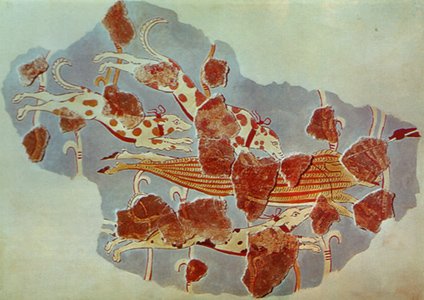
Period:-
- Cycladic culture – Early Bronze Age (About 3000-2200 B.C.)
- Minoan Culture – Middle Bronze Age (About 2200-1800 B.C.)
- Mycenaean culture – Late Bronze Age (1600-1200 B.C.)
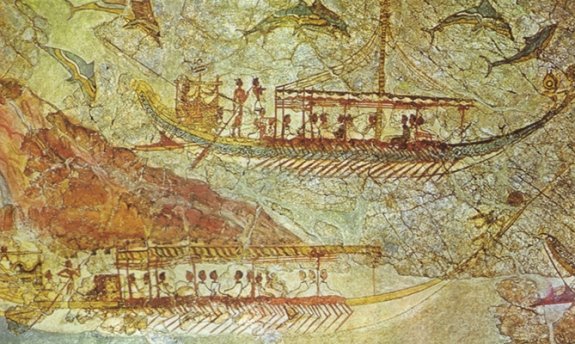
Cycladic culture:-
The Cycladic civilization of the Aegean Sea flourished at about the same time as the early Egyptian and Mesopotamian civilizations. That is considered the forerunner of the first truly European civilization – Greece.
On the mainland their villages have been small independent units, often protected by thick walls. Over time, the buildings on Crete and in the Cyclads became more complex.Cycladic culture developed pottery, often decorated with rectangular, circular, or spiral designs. They also produced silver jewelry. The sculpture produced there was very unique compared to the art being produced by the Egyptians and Mesopotamians.
Minoan Culture:-
Newcomers arrived in the Cyclades and on the mainland and caused destruction. For about two centuries civilization was disrupted. New pottery and the introduction of horses at this time indicate that the invaders were of the Indo-European language family.
Minoan culture developed on Crete, in the 2nd millennium B.C. Impressive buildings, frescoes, vases, and early writing are evidence of that flourishing culture. Great royal palaces built around large courtyards were the focal points of these communities. The Minoan empire appears to have coordinated and defended the bronze-age trade. They maintained a marine empire, trading not only with the Cyclades and the mainland but also with Sicily, Egypt, and cities on the eastern shore of the Mediterranean. Minoan religion featured a female snake deity, whose worship involved the symbolism of fertility and the lunar and solar cycles.
Mycenaean culture:-
It is believed that the Mycenaeans were responsible for the end of the Minoan culture with which they had many ties. This theory is supported by a switch on the island of Crete from the Cretan Linear A Script to the Mycenaean Linear B style script and by changes in ceramics styles and decoration. The styles on painted vases and weapons that depicted hunting and battle scenes are more formal and geometric than those of earlier examples, anticipating the art of classical Greece.
The architecture and art of Greek mainland was very different from the one of Crete. Mycenae and Tiryns were two major political and economic centers there at the time.

Concept of Aegean art:-
The art of the Bronze Age civilization in the Cyclades Islands, about 2500–1400 BC, is exemplified by pottery with incised ornament and marble statuettes, usually highly stylized female nudes representing the Mother Goddess in almost abstract simplicity.
Characteristics of Aegean Art:-
- Elongated oval faces
- Triangular nose
- Gold masks
- Sturdy Architecture
- Spontaneous style
- Decorative Zigzags
- Running spirals
- Simply delineated
Techniques of Aegean Art:-
The techniques of Aegean art are by representing proportionate but similar figure in order to show that something belongs to a similar group. Like a family will be represented by having same figures varying only in sizes. The biggest of all represents the father, a little bit smaller one represents mother and the tiny ones represent their children. Similarly if they want to represent a clan then the largest figure represents the leader of the clan.
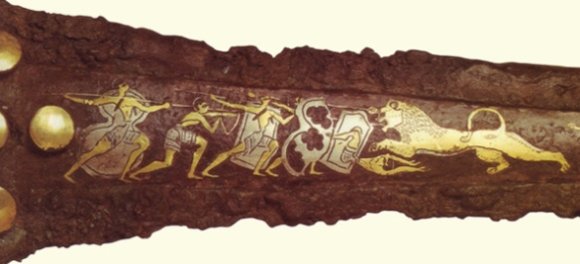
Subjects of Persian Art:-
- War faring imagery
- Images of harvest, and light, breezy, unwarlike architecture
- Depicting scenes from everyday life, plants, birds, leaping fish, and dolphins
- Swimming octopi with clutching tentacles covered the surfaces of vases, interspersed with argonauts, starfish, corals, shells, and jagged rocks
Media of Aegean Art:-
- Bronze
- Fragment remains
- Frescos
- Obsidian
- Rock-crystal
- Porphyry
The culture came to an end when, after the eruption of the volcano on Thera (now Santorini) and the destruction of the Minoan centre on that island, the Mycenaeans gained control in the Aegean.
Many of the ideas and art forms of the Mycenaean and other early seafaring civilizations were later adapted by the Greeks.
All images credits goes to: all-art.org





nice article
Thank you Diana. Your comments are really boosting. Look into other design history articles and tutorials also.
The things that i had learned from this one are all unfamiliar. That’s why i am so thankful for the person behind this blog. I really like this one.
Thank you delaila. Stay in touch for more articles like this. You will come to know about more things in future. This is an episodic post so please visit us without fail on thursdays to know more about design history.
very interesting stories.
These are facts collected after longtime research and information gathering.
History of Aegean in a design blog. Innovative idea. Thanks for sharing.
We have also posted other design history in the previous episodes and will post in the future episodes also. Please stay logged in.
Great article, thanks 🙂
Thank you Jeffrey.
Very Nice. Thanks.
Thank you Micha.
Thank you Ryan, these are not comments, these are compliments.
Great Work Sipi 😀
Aegean art was an important on classical greek art, which had a tremendous influence on western civilization and art.
Hey,
This definitely helped.
Thanks
Your information was quite helpful and I have cited your works in my mid term paper in art history. I find it rather sad that the only other works that I could find about ancient Aegean art was in travel guides or through a travel sight. Thank you for your page it gave me enough clues and hints to look for other key words and now I have the information I needed.